Province of Pistoia
Holiday in Tuscany villas, far from the madding crowd

Province of Pistoia
Pistoia and its surroundings have an ancient history, reaching the top of their splendour during the Middle Ages, when many noble families decided to build their villas and manor houses in the town and on the surrounding hills. In fact many villas for rent in Tuscany are located in this area. A number of these mansions, perched on the gently rolling hills, later became wine estates for the Chianti “Montalbano” production. In the last decades some of them have been renovated, so that guests can choose between many striking accommodations in the Pistoia area.Regarding the history of the town, Pistoia, was a Roman colony, used as military stronghold against the Ligurian tribes living in the nearby Apennines. During this period, Pistoia developed because of the road network built by the Romans. In fact the opening of a new stretch of Via Cassia (the consular road linking Rome with the Etruscan cities of the interior and Lunigiana) made it a junction of primary importance.
Recent archeological investigations in the area of the cathedral San Zeno have revealed the continuity of the urban strata, spanning more than twenty centuries of history.
Actually it played in the 4th and 5th centuries an important role at the time of barbarian invasions, putting up a long resistance to the advance of Longobards.
The economic success certainly stemmed from its position in the road system, but the abundant supply of water and the timber of the nearby mountains played a fundamental role in the emergence of manufacturing activities such as wool, paper, wood, still flourishing today. Nor should we forget the smelting of iron ore from Elba isle, already under way in the Etruscan period and elevated to the status of a true “industry” under the Medici.
However the precocious “industrial” vocation was not matched by an adequate political stability and the city after the 13th century golden age lost its political influence, falling under the sway of Pisa, Lucca and finally Florence in 1530.
The shared artistic heritage is quite evident in the Romanesque style of the Pisan-Luccan style of the cathedral of San Zeno, hub of the city's memories.
Travellers in the past have remarked on the quantity and quality of the sculptures and carved decorations which appear to be a distinctive trait of religious architecture in Pistoia, difficult even to hint in a such scanty amount of place.
Let us remember the cathedral portico decorated by Andrea della Robbia, the numerous lintels carved in relief by Gruamonte, the pulpits of great value by Giovanni Pisano or churches like Sant'Andrea, San Bartolomeo in Pantano, San Pier Maggiore, San Giovanni Fuorcivitas, San Paolo, San Francesco and the later basilica of the Madonna dell'Umiltà, whose powerful impact on the city's skyline is due to the imposing dome built by Vasari in the 16th century.
Last but not least the former monastery of Sant'Antonio Abate, splendidly frescoed in the 14th and 15th centuries which now houses the center named after Marino Marini, the important 20th century sculptor, born in Pistoia and much appreciated by international art collectors such as the American Peggy Guggenheim.
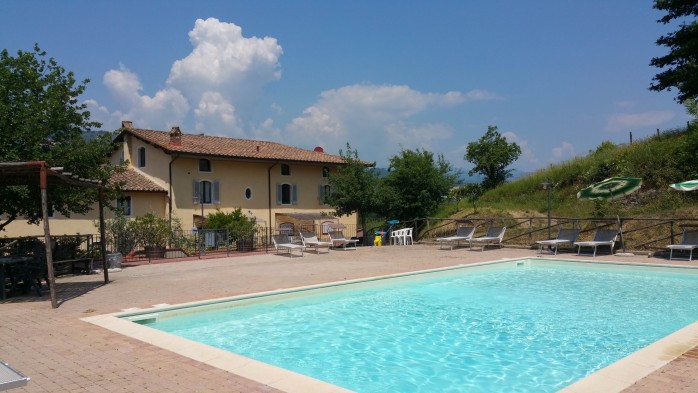
Serravalle Pistoiese - RIF. S291
This holiday farmhouse is part of a wine estate, located between Florence and Lucca, at 1 km from the village of Masotti and is surrounded by a luxuriant countryside with vineyards and olive groves. The owners’ family farmhouse and a small farmer’s house have recently been renovated and converted into apartments for holiday rentals. They consist in 4 flats in the main house plus a romantic cottage in a detached building. At guests disposal a swimming pool (12x6 m, open Jun-Sept), washing machine, internet Wi-Fi connection and barbecue for al fresco dining. The estate’s owners organize wine and olive oil tastings for those interested.
The nearest shops, restaurants and train station are in the village at 1 km.
Lucca is at 37 km, Florence 41 km, Pisa 51 km, the Versilia coast at 60 km, while the relaxing spa town of Montecatini is a just 10 km. An ideal position for those wishing to spend a quiet vacation in the countryside and for those who have cultural and art interests.
CIN IT047020B5ZPQBC8FE
[Continues..]
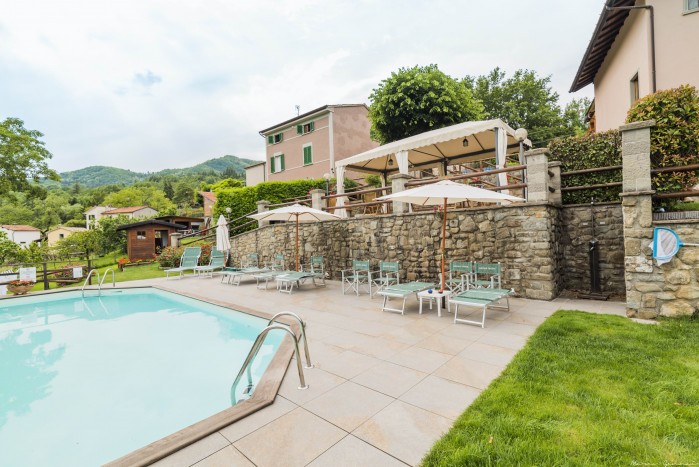
Le Piastre - RIF. S33
Located in a tiny, old hamlet at 740 m above sea level, and 15 km from Pistoia, these holiday apartments for rent in Tuscany are in a quiet area, far from the madding crowd, with a spectacular panoramic view. Perfect for a relaxing holiday surrounded by nature, the property has large lawns framed by flowerbeds, a children’s playground, a barbecue and a swimming pool (11x5). Also available internet connection, laundry and, new: Jacuzzi and sauna (fee applicable). Nearby there is a stream along which one can take long walks. Typically Tuscan, the owners are a lovely couple, very warm and attentive, as well as generous.
These holiday accommodations consist of 6 apartments, tastefully furnished and each with a private terrace/garden area, which can comfortably accommodate up to 24 people. In the surroundings one can visit medieval villages and an ancient factory, where ice was once made, called Le Piastre on the river Reno. These holiday apartments with swimming pool in Tuscany are in an ideal position for daily trips to the art cities of Florence, Pisa or Lucca. The nearest shops and restaurant are at Le Piastre at 1,5 km.
CIN IT047014B5XOZMS2UY - IT047014B477LLRS3V
[Continues..]
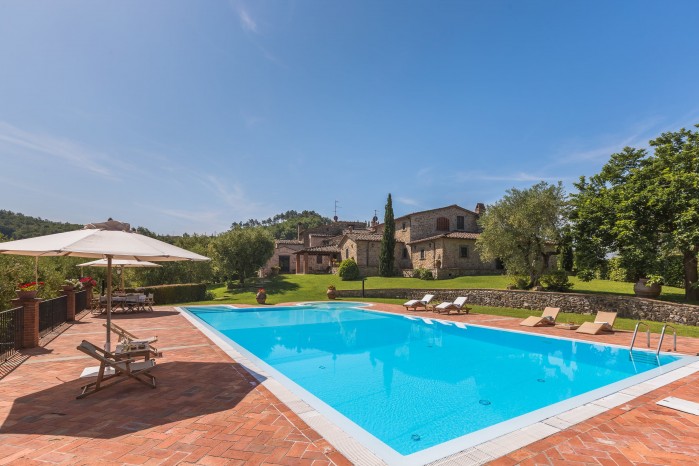
Monsummano Terme - RIF. S388
This charming stone villa with swimming pool is located on the fertile hills of the Valdinievole at just 2 km from the popular spa resort of Monsummano Terme.
Originally an 18th-century farmhouse made with local stone, today the villa is set within a large garden full of luxuriant plants and precious Tuscan terracotta vases. An infinity pool (16x8 m, depth from 1.35 to 2.50 m, open from mid-April to mid-October) with very large Jacuzzi area for 8 people is situated in a scenic spot enjoying generous views over the surrounding countryside. Under the pool, which is fitted with night lighting and an acoustic pool alarm system for the security of our smaller guests, there is a large changing room with 2 showers and a two piece bathroom. There is also a gym room equipped with treadmill with digital display, multifunctional Technogym bench, stationary bicycle and also a football table. The garden also features various furnished areas, perfect for al-fresco dining, amongst which are a relaxing stone amphitheatre, a barbecue and a children’s corner with a swing and slide. Definitely an ideal position for all those seeking peace and quiet.
On two floors, the villa, 350 sq m, can accommodate up to 11 guests. It is elegantly furnished with extraordinary antique pieces collected with taste through the years, and with wooden beam ceilings and beautiful antique terracotta tile flooring lovingly restored by the owners.
On the ground floor there is a large living-dining room (80 sq m)
[Continues..]
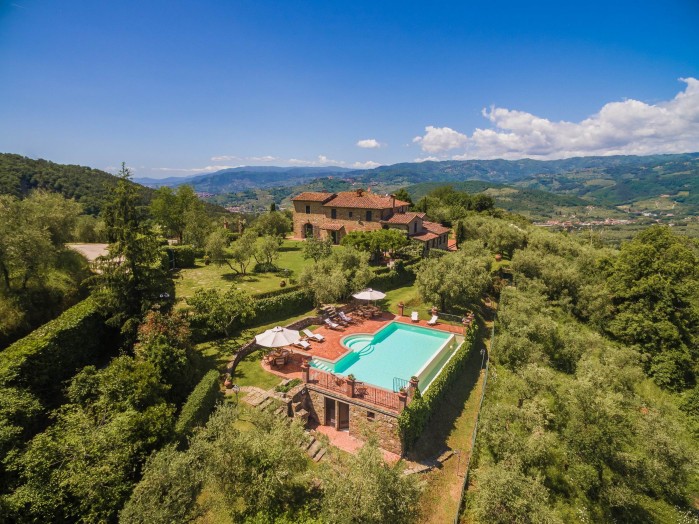
Monsummano Terme - RIF. S387
This stunning 18th-century villa with an exclusive pool is located near the popular spa resort of Monsummano Terme, surrounded by the luxuriant countryside of the Valdinievole.
A typical Tuscan stone house, the villa is set within a large garden with an infinity pool with hydromassage (12x6 m, depth 1,40 m, open from mid-April to mid-October). The pool and property enjoy breathtaking views over the surrounding hills covered with olive groves and woodland and are situated in an ideal position for all those seeking peace and quiet. Underneath the swimming pool is a changing room with a shower and a two-piece bathroom. The garden also features a furnished gazebo, perfect for al-fresco dining, a barbecue and a children’s play area with a swing and slide.
Elegantly furnished with period furniture, the villa, 500 sq m, can accommodate up to 19 guests and is on two levels, plus an intermediate floor.
The ground floor consists of a lounge with a double-sided fireplace which leads into another lounge with a dining area and 16-seat table; a main kitchen, fully-equipped (side-by-side fridge with ice-maker, oven, dishwasher, microwave, Nespresso coffee maker, American coffee machine, moka pot, toaster, blender, fruit juicer, sterilizer for baby bottles, water purifier and sterilizer for potable water: plain, cold and sparkling) with 8-seat table, fireplace and antique bread oven; another dining room for 8 people; a third lounge with a double sofa bed, a beautiful antique fireplace a
[Continues..]
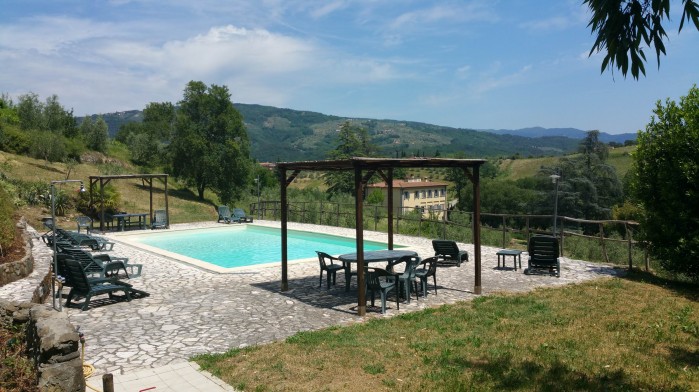
Serravalle Pistoiese - RIF. S290
This large 19th-century villa is located near Serravalle (3 km), a small medieval village between Florence and Pisa. The village is situated on the top of a hill, and has 2 towers with a stunning view (one towards Florence and the other towards Pisa); thanks to its two towers the settlement had a strategic position during the Middle Ages.
Located in a quiet position, in the middle of a large park with century-old trees, the villa, 600 sqm, with private swimming pool (12 x 6 m, depth 90-140 cm, open June-Sept, with shower), is vast and has over 20 rooms. The large gardens and outdoor spaces are ideal for a relaxing holiday, and for a walk in the nature; you can also relax at the gazebo overlooking the olive groves, enjoying a good glass of wine, while preparing your barbecue. Owners are available if you want to visit the wine cellar of the estate and taste the excellent wine or olive oil produced here. On request you can also have a cook, pre-arrival grocery service, housemaid, private driver.
Distances: nearest shops, restaurants and train station 1 km; Lucca 37 km, Firenze 41 km, Pisa 51 km, sea or beach 60 km, Montecatini Thermal Baths 10 km.
The villa is on 3 floors, furnished with original pieces and taste, and can host up to 19 people (7 bedrooms + sofa beds). At guest’s disposal internet Wi-Fi, Sat-TV.
Ground floor: beautiful entrance hall with old stone staircase, separate toilet. On the right side there is the TV hall and a double bedroom with a bathroom/shower
[Continues..]
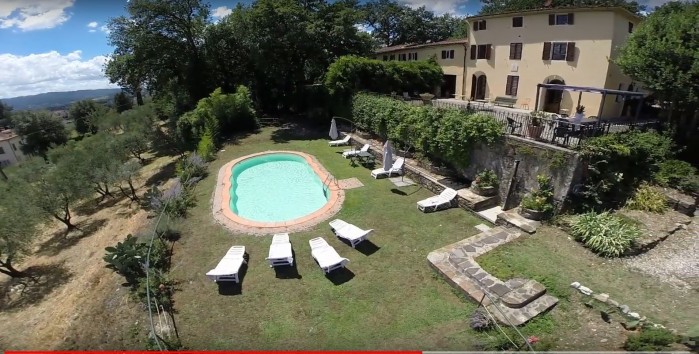
Pistoia - RIF. S176
This lovely villa for rent in Italy is located just outside the medieval town of Pistoia (2km),, on a hilltop with a breathtaking view over the plain as far as Florence, where, on a clear day, one can also see the Cathedral. The holiday accommodation is surrounded by olive groves, vineyards and oak woods and has recently been restored maintaining its original characteristics such as the wooden beam ceilings, the vaulted ceilings, the terracotta tile flooring and the parquet flooring. This spacious 18th century villa is on 3 floors and can comfortably accommodate up to 10 people. On the ground floor there is the entrance, a fully equipped kitchen, a study and a large dining/living room both with access to a terrace with a panoramic view, a cellar/utility room and a built-in closet. On the first floor there are 2 twin bedrooms, 1 double bedroom, 1 large bathroom fitted with shower and also a toilet. On the second floor there is a twin bedroom, 1 double bedroom and 2 bathrooms with shower. The larger bathroom and the 2 bedrooms flaunt wonderful wall paintings that simultaneously trick and delight the eye. Antique furnishings, drawings and paintings, mostly family heirlooms, are strewn around the house. Windows with mosquito screens. shaded by laurel shrubs offering shelter from the sun, which includes a swimming pool (10x5mt, open May-Sept) and a barbecue. The owners, both wine and olive oil producers, live in the country house near the villa and are available for inform
[Continues..]
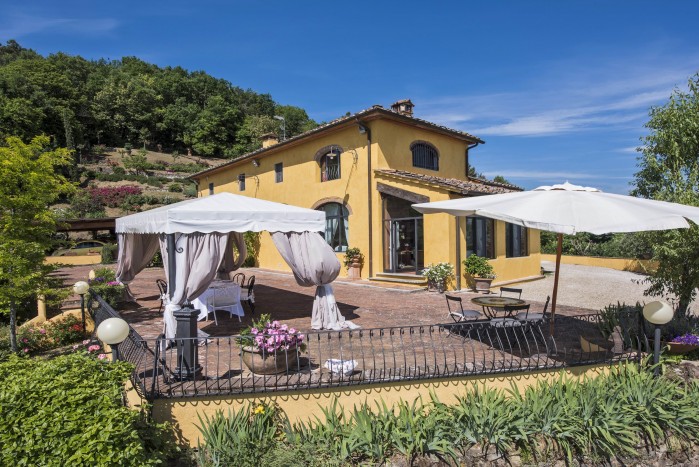
Casalguidi - RIF. S366
This stunning villa with swimming pool and large park with olive grove, fruit trees and rose garden, is located near Pistoia. Upon arriving at the villa, you will immediately have the impression that you are in a unique place, overflowing with colours, fragrances and light. The large swimming pool (12x6 m, 1.40-1.50 m deep, open 1th Apr-30th September) is set in a position with a lovely view, and with various spaces where guests can relax: a lounge area at the pool, with a changing room, a fridge, a toilet and a shower, as well as a gazebo for al fresco dining and a barbecue area. A children playground.
The split-level villa is 450 sq m on two floors, finely furnished and can sleep up to 14 people.
Entrance is on the ground floor, with access to a large living room which opens also onto to a furnished veranda, and view over the countryside. Also featuring a piano, Sat TV, a DVD player, a fireplace and a dining area. Furthermore, on the same floor there is a bathroom with shower, whereas a staircase leads to a separate gallery with a double bed. On another level there is a second living room with a fireplace and dining table, and next to it a fully equipped kitchen (electric stove, oven, microwave oven, dishwasher, fridge with freezer, toaster, kettle, coffee machine, blender, fruit juicer, and a pizza oven), and a laundry with washing machine and dryer.
In the bedroom/bathroom area on the ground floor there are 2 double bedrooms with en suite bathrooms (one with shower
[Continues..]
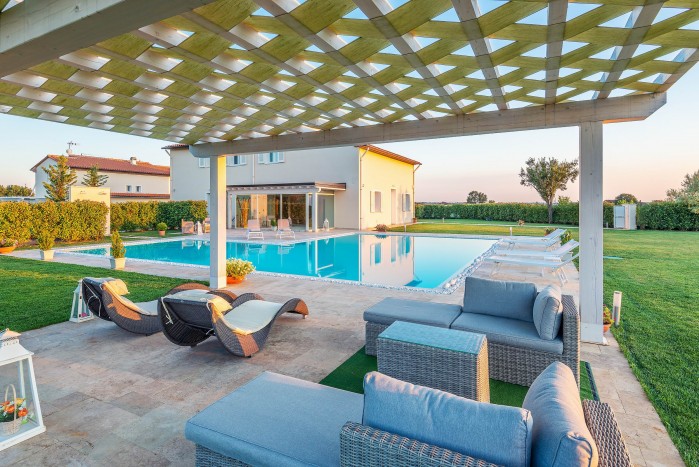
Montecatini Terme - RIF. S363
Stunning large villa of 340 sq m located 6 km from Monsummano Terme, popular spa resort renowned for its wellness treatments as well as the nearby Montecatini.
The villa is furnished in modern style, where the elegance of form and colour reign supreme. It is, furthermore, a perfect spot for those who want a holiday in total privacy, relaxation and tranquillity in the Tuscan countryside, but who also want to go shopping and have transport nearby. The nearest town, Cintolese, with shops, supermarket etc is 1,5 km away.
The villa is surrounded by a large, well-cared garden, furnished with a pergola for al fresco dining, barbecue, as well a lounge area at the big L-shaped pool (11 x 7 metres, with 4 x 5 metres extension).
On two floors, the villa can accommodate up to 13 people. Ground floor: there are various open areas, divided into a dining area, a well equipped kitchen (stove, fridge with freezer, oven, dishwasher, microwave oven, kettle, blender, toaster, American and espresso coffee machine, ice-maker), a lounge area with sofas and Sat TV and stereo system. A double bedroom with Sat TV, en-suite bathroom with shower, and access to the garden. A laundry room with a washing machine and a dryer, as well as iron and ironing board. A Spa area is also located on the ground floor: hot tub (3,80 x 2,5 m, 1 m depth), sauna, Turkish bath of 4 sq m, 2 heated spa loungers and a view over the outside area, 2 changing rooms with toilet, showers and a bathroom suitable for disabl
[Continues..]


© 2025 copyright Tuscany Holiday Rent S.L. - Calle Gema 4, 41020 Sevilla ,
P.iva ES B90300302
info@tuscanyholidayrent.com
info@tuscanyholidayrent.com